
Automated Shopping Cart Builder Adopted by Kroger and Wegmans
The AI shopping assistant developed by Cooklist has officially launched and has been adopted by retailers such as Kroger and Wegmans, capable of automatically generating shopping carts based on customer descriptions. This technology combines the functions of a personal shopping advisor, head chef, and nutritionist, aiming to eliminate shopping friction. Currently, the service covers over 700 stores in the United States, with plans for further expansion.
When Daniel Vitiello and Brandon Warman launched their Cooklist recipe-building app in 2018, the concept of using computer intelligence to converse with customers and automatically place groceries into an online shopping cart was still a futuristic idea.
Although that kind of human-computer interaction was still years away, Vitiello and Warman believed from the start that artificial intelligence would eventually evolve to handle nearly every aspect of the shopping experience—so they set their sights on building such a tool.
"We set a mission for the company around 'intelligent eating,' which means we want to combine the intelligence of a personal shopper, a private chef, and a nutritionist to help predict your needs and achieve your goals, and really remove all friction from grocery shopping," Vitiello said.
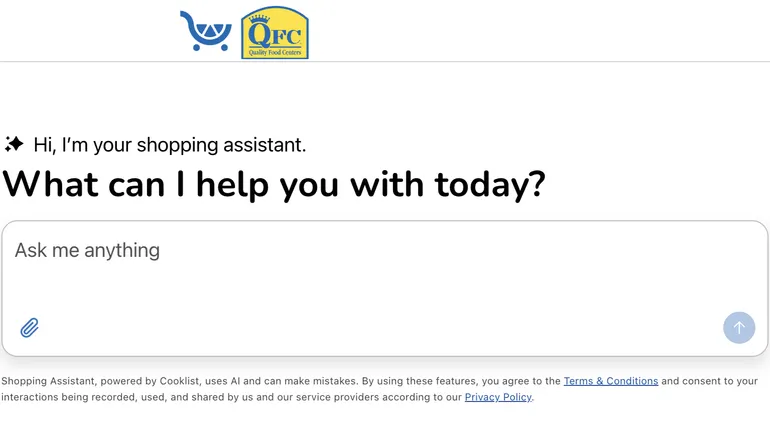
Last week, Cooklist officially announced it has achieved that goal and is now offering technology that lets grocers provide an agentic shopping experience simply by integrating the startup's code into their e-commerce platforms. The company's first customers include Wegmans and Kroger, both of which now offer customers an online assistant on their websites where shoppers can describe their needs and then receive a cart filled with recommended products.
According to Cooklist, Kroger brands currently using its technology include Fred Meyer, Ralphs, Baker's, Dillons, QFC, and Smith's.
Cooklist is not the only company advancing agentic AI in the grocery space. In December, Albertsons launched its own agentic AI shopping assistant. Third-party e-commerce service providers such as Instacart, DoorDash, and Uber also offer agentic AI capabilities to grocers.

A Kroger spokesperson declined to comment on its partnership with Cooklist, and Wegmans did not respond to a request for comment. However, the AI assistants available to customers logging onto both retailers' websites note that they are "powered by Cooklist." Wegmans' assistant reminds customers that the tool is in beta and asks them to confirm their understanding of its experimental nature before using it.
Cooklist's technology is currently available to customers of seven grocers, covering more than 700 stores across the U.S., and the company expects to expand to roughly 700 more locations in the coming weeks. The expansion includes 10 additional regional and national grocery brands, though the company did not disclose their names.
Vitiello said Cooklist is able to integrate its agentic AI technology into e-commerce platforms in about six weeks. He added that the company's selling points include allowing retailers to add agentic AI to their customer-facing systems without having to develop those capabilities themselves and without ceding control of customer data to third-party providers—such as Instacart, which many retailers rely on—to offer AI-based shopping tools.
"With Cooklist, retailers own all their data. They have complete control over how everything works," Vitiello said. "We really help customize it to work the way they want and integrate with their existing systems, so we're finding there's demand for that model in the market right now."
According to the company, Cooklist's technology serves not only as an online shopping aid but also as a way to drive people into physical stores. Vitiello said about half of customers using assistants based on Cooklist's technology end up visiting a physical store to complete their orders, adding that in some cases, nearly a third of queries handled by grocers' assistants are support-related. The technology can also guide customers to products as they walk through store aisles.
"Another thing retailers are thinking about is... not just as a shopping assistant, but how can it help store operations more broadly and take load off customer support teams?" Vitiello said.
Warman noted that customers conversing with AI-based tools are willing to provide more information than when typing details into a search engine. People using the Cooklist platform average about 50 characters per chat message, whereas search queries are typically only 10 characters.
"We get about five times more information from users each time, which really gives us a better understanding of the intent behind their inquiries and helps us understand the 'why' behind what gets added to their carts," Warman said.
According to Vitiello, recent AI investments by Amazon and Walmart have helped drive retailer interest in Cooklist.
"For years, we felt like we were pushing a boulder up a hill, trying to sell and acquire customers, and over the last 12 months, it's been completely the opposite—we've been overwhelmed with demand," he said.
Vitiello also said Cooklist is able to leverage intelligence gained from customers' conversations with its agentic AI system to provide insights to product and merchandising teams.
"We can actually generate reports from interactions with the assistant and then send them to the produce team, the meat and deli team, and the dry goods team... That's where we connect the digital voice of the customer to all the different departments within the retailer," he said.