
Six Trends to Watch in the Grocery Industry in 2020
In the nearly three years since Amazon acquired Whole Foods, grocers have been forced to test and invest at a faster pace than expected. Now they are gradually finding their footing, delivering a better shopping experience for consumers. In 2020, retailers will focus on expanding several of the most promising services and technologies to gain a competitive edge in food retail over the next decade.
Nearly three years after Amazon acquired Whole Foods, grocers have had to test and invest faster than they ever expected. Now, they are gradually finding their footing, and consumers are reaping the benefits of a noticeably improved shopping experience. Looking ahead to 2020, retailers will focus on advancing a range of the most promising services and technologies, laying the groundwork for food retail competition in the next decade.
Premium and specialty private labels will accelerate their launch
From Target's Good & Gather to ShopRite's new food and home brands, retailers in 2019 pushed their private labels into new premium categories. Tory Gundelach, senior vice president at Kantar Consulting, told Grocery Dive she expects retailers to continue expanding their boutique and specialty product lines in 2020.
"I think in 2020 we will see the next step of this trend, whether it's plant-based private label products or alternative protein private label products," Gundelach said.
Experts generally agree that alternative proteins will become the next frontier for private labels. Currently, this space is dominated by a few companies like Impossible and Beyond Meat, but grocers are beginning to get involved, most notably Kroger, which launched its Simple Truth Plant Based line last fall.
Given the extreme popularity of this category, the biggest obstacle may lie in finding suppliers.
"I'm not sure there is currently enough manufacturing capacity to meet the current demand for plant-based products," said Jim Hertel, senior vice president at Inmar Analytics.

A report from retail consulting firm Daymon found that 20% of private label sales growth comes from premium products. Andrew Moberly, director of category solutions at Daymon, noted that premium store brand lines are crucial for enhancing customer loyalty.
Neil Saunders, managing director of GlobalData Retail, believes retailers will increasingly use store brands to differentiate their grocery offerings, introducing novel products more complex than household staples—such as meal solutions and value-added meal kits.
"Retailers are becoming more confident and willing to push these higher-priced items within their private labels," Saunders told Grocery Dive.
Grocers will heavily invest in micro-fulfillment centers
In 2019, several retailers signed on to pilot micro-fulfillment centers (MFCs), and this year the pace of grocers' facility deployment is expected to be at least three times that of last year, predicted Chris Walton, former Target executive and founder of Red Archer Retail.
So-called MFCs combine the efficiency and precision of large warehouse sorting with the advantages of store-based picking close to consumers—the latter still being the primary model for e-commerce fulfillment.
Most retailers choose to co-locate MFCs with existing stores, either by adding facilities or retrofitting existing space. The "omnistore" concept developed by Locai envisions placing micro-fulfillment at the center of the store, handling ambient product fulfillment while consumers shop in surrounding departments. Other companies are building standalone facilities that can serve as forward warehouses for one or more grocers.
MFCs are not a panacea for the inefficiencies of online grocery fulfillment. Items like fresh produce cannot be handled in automated systems and require a combination of manual and robotic picking. In a recent earnings call, Ahold Delhaize CFO Jeff Carr said that before expanding beyond a single pilot MFC at a Stop & Shop in Hartford, Connecticut, executives still "need to be convinced that we can achieve labor efficiency."
But according to analysts at financial institution Jefferies, MFCs remain the most viable technology for improving e-commerce metrics. The firm noted that the technology builds quickly, leverages existing assets, supports rapid delivery and pickup, and can eliminate more than 75% of labor costs.
In-store dining will see an upgrade
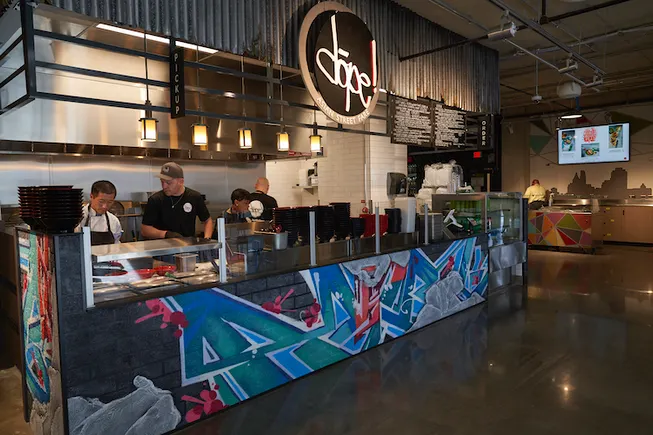
In-store restaurants help grocers attract new customers and add foodservice revenue to the bottom line. Stewart Samuel, program director at IGD Canada, said this year they are expected to further drive this trend by adding destination-style food halls.
"In the U.S., I see more focus on the food hall format, where they add elements like wine bars, craft tasting rooms, or food counters," he told Grocery Dive.
In 2019, Whole Foods opened its two-story Mid-Atlantic flagship store in Tysons Corner, Virginia, featuring a food hall housing Officina, an Italian restaurant by Michelin-starred chef Nicholas Stefanelli, as well as specialty brands like Curiosity Doughnuts, Rappahannock Oyster Co., and Genji Izakaya.
Kroger also debuted a food hall in its new two-story urban store in Cincinnati. Named On The Rhine Eatery, the food hall houses five restaurants covering Asian cuisine, barbecue, and food truck-style fare, with indoor and outdoor seating and a full-service bar.
Samuel said these food halls, which are mainly emerging in cities but may soon expand to suburbs, are part of grocers' store remodeling plans aimed at giving customers reasons to visit beyond routine shopping.
Retail apps will move toward consolidation
Grocers have begun to realize the need to reduce the number of e-commerce apps and tools, and as their operations mature, Kantar's Tory Gundelach said they will continue to streamline their customer-facing digital assets.
"We built this ecosystem or network—you could say, to meet customers' needs for different fulfillment methods, we made it very complex," Gundelach told Grocery Dive. "Where possible, retailers will begin to consolidate services into one app, one ordering mechanism."
This simplifies not only the customer experience but also the retailer's own operations. Gundelach mentioned one example already emerging in the industry: Shipt's integration into the Target app. In November, Target announced it would offer same-day delivery of groceries and other items through Shipt within the Target app.
H-E-B has also launched a new app through which customers can order groceries, redeem coupons, create shopping lists, and more, aiming to provide a richer, more seamless experience.
Grocers will finally figure out artificial intelligence
For years, grocers have struggled to understand artificial intelligence (AI), let alone integrate it into their operations. But Bill Bishop, chief architect at Brick Meets Click, said that more than two years after Amazon disrupted the industry, retailers are gradually mastering the technology and its uses.
So far, companies have used AI for targeted tasks such as reducing food waste and improving promotional flyers. Bishop said this year retailers will make progress in two key areas: demand forecasting and analysis of customer purchase data.
Advances in AI technology will help grocers track and analyze customer purchasing behavior more closely, and also enable them to stock stores more precisely, refining demand forecasting to the individual item level rather than just the case level.
"By doing this, you can significantly improve inventory turnover and increase the efficiency of the entire process," Bishop said.
He said the result will be better economics for grocers and a more personalized shopping experience for consumers.
"It's about winning customers, not just pushing more products at customers," Bishop said.
Retailers will play a deeper role in customer health
Retailers have long marketed health concepts and sold healthier products. Now, in seeking to boost loyalty, they are increasingly becoming health destinations, offering an expanding range of specialized services.
"This is something we've seen over the past few years, and we expect this trend to continue growing," Samuel told Grocery Dive.
Walmart is piloting its own clinic, Walmart Health Center, while Kroger and Publix have partnered with local hospitals to offer integrated care options. To attract more customers to its pharmacies, Albertsons is offering genetic testing services at stores in Idaho and Pennsylvania.
According to a new report from the Food Marketing Institute, 71% of food retailers view health and wellness as a growth opportunity for their business.
Samuel said in-store product assortments may also see more shifts in 2020, such as adding more plant-based products and other items that help consumers meet specific lifestyle and dietary needs.
"Grocery retailers really have a strong reason to play an important role in helping consumers lead healthier lifestyles," Samuel said.