
Wegmans Brooklyn Store: The Brand's Biggest Test Yet
On Sunday morning, hundreds of customers braved rain and waited in line for hours to enter Wegmans' first store in New York City. The 103-year-old supermarket chain is testing the urban market with a compact 74,000-square-foot format, which analysts say will test its adaptability and could provide a template for entering downtown areas like Philadelphia and Chicago.
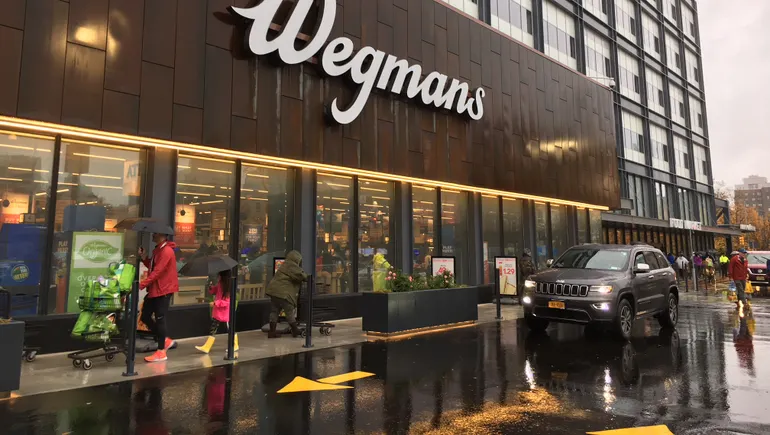
On a chilly Sunday morning, many shoppers might forgo a trip to the grocery store, opting instead for the convenience of delivery. But in Brooklyn, hundreds of people were willing to queue in the damp weather—some even waiting in the dark for nearly seven hours—just to step into New York City's first Wegmans store before 7 a.m.
At the front of the line were a group of women calling themselves the "Wegmans Women," dressed in pink Wegmans apparel, who met nine years ago at a store opening in Virginia and have since attended more than a dozen similar events together. Further back was Dave Alder, who left at 1 a.m., drove three hours, wearing a "Wegmans, People Make the Difference" T-shirt from when he worked at a store in the early '90s. And there were customers like Kimberly Chia, who grew up with the supermarket chain and has missed it since moving away.
People came from all over the country, including Wisconsin and Texas, just to be part of the latest store opening for this chain with a cult following, a rarity in the grocery industry.
"I'm obsessed with Wegmans. It's literally the best place on earth... (My friends) think I'm crazy, but I believe they've never experienced Wegmans," Emily Lobello, who lives in Albany, New York, told Grocery Dive. "It makes grocery shopping a really enjoyable experience, (and) I think a lot of people are always so negative about it."
Inside the store, Kevin Cuff, the new manager and a 21-year Wegmans veteran, gave final words of encouragement to employees.
"They said we couldn't open a store in Brooklyn. They said we couldn't find employees in Brooklyn," he said. "For Wegmans employees, today is your day. Many of you trained in New Jersey for six, seven, eight months, away from your families, just for today, and today has finally come."
Moments later, the doors opened and people streamed in, waving, smiling, and high-fiving friends. Several raised their arms, capturing the moment on their phones. As the morning wore on, the rain outside intensified, but curious new customers and devoted Wegmans fans kept pouring in. Cars could be seen circling the parking lot in search of a precious spot.
A devoted following
Wegmans has thrived in the suburbs of the Northeast and mid-Atlantic with its massive stores, which can reach 140,000 square feet, nearly the size of three football fields. But the retailer is gradually stepping out of its comfort zone. In recent years, it has expanded southward, going head-to-head with beloved supermarkets like Publix.
Despite Wegmans' success in opening large new stores, replicating that success at its new 74,000-square-foot location in the Brooklyn Navy Yard is fraught with uncertainty, and could be the biggest test yet for the 103-year-old grocer. Analysts say that if it succeeds here, the store could serve as a blueprint for Wegmans to enter other urban centers like Philadelphia, Cincinnati, or even Chicago, while further cementing the popular chain's ability to adapt to a rapidly changing food landscape.
The family-owned business, which started with a produce cart in 1916, has grown to 101 stores across seven states, with nearly half in New York. Wegmans has flourished even as other supermarket chains have collapsed or struggled to compete with discounters like Walmart, Aldi, and Lidl, as well as the rising e-commerce giant Amazon.
The grocery industry's economics remain tough, with razor-thin margins that squeeze the funds available for chains to invest in operations. But Wegmans, along with regional retailers like Iowa's Hy-Vee and Texas' H-E-B, stands out as a success story, proving that supermarkets can thrive with the right store experiments, product mix, measured expansion, and a loyal customer base.
"They've even created a cult following in markets they haven't entered yet, because of the stories, because of the people who have shopped there," Phil Lempert, founder and editor of SupermarketGuru.com, told Grocery Dive. "These stores are fantastic. No question about it."
Bill Bishop, a longtime grocery consultant and chief architect of Brick Meets Click, said Wegmans has set itself apart from competitors by being "really detail-oriented" and prioritizing the customer experience before it became trendy.
Bishop recalled a story about Robert Wegman, son of the company's co-founder, worrying that the traffic light in front of the company's first store near Washington, D.C., wasn't letting enough cars through each cycle. Legend has it that a few weeks later, he managed to get the signal adjusted.
Everything you could want
Customers entering the Navy Yard Wegmans are greeted by displays of cauliflower, broccoli, strawberries, lemons, and sweet potatoes. Throughout the morning, staff kept replenishing items like Brussels sprouts and grapes, even as shelves remained well-stocked.
Wegmans customers often praise its prepared foods, and the Navy Yard store has deployed many of these offerings. To the right of the entrance, Wegmans has clustered coffee, a custom pizza station (selling slices as early as 7 a.m.), a burger bar, custom salads, sushi, and self-serve hot and cold bars, including craft beer BBQ chicken wings and cauliflower spinach gratin.
Nearby are soup stations and packaged ready-to-eat entrees and sides, ranging from lobster rolls, garlic parmesan tilapia, to 24-count deviled eggs, artichoke bruschetta chicken breast, and homestyle beef patties. A mezzanine level upstairs features nearly 100 seats, and a bar serving wine, cocktails, and draft beer.
The Navy Yard store carries a total of 50,000 items, including over 300 cheeses, hundreds of produce varieties, 2,000 organic products, dozens of fresh baked goods (such as cookies, doughnuts, muffins, and boiled bagels), and breads and rolls made from grain grown near Wegmans stores—a feature highlighted in in-store displays.
The new store also experienced the typical growing pains of opening day. One customer asked about Boss Sauce—a sweet and tangy condiment made in Rochester, New York, where Wegmans is headquartered. An employee apologized, saying the store's smaller size meant a reduced selection, and promised to pass the request along to management, noting that several other customers had also asked about the item.
Shoppers at the Navy Yard store navigate with compact shopping carts, bypassing the larger carts common at most locations. Wegmans has also stacked items like soda, chips, Gatorade, honey nut cereal, granola bars, and Fritos on top of shelves, often still in cardboard boxes or plastic wrap, clearly to maximize space.
An unknown risk
According to company website data, Wegmans had sales of $9.2 billion in 2018, covering 98 stores (including 3 opened that year). By comparison, grocery giant Kroger, with about 2,765 retail stores, had sales of $121.2 billion in fiscal 2018; Albertsons generated $60.5 billion in revenue across about 2,270 stores; and Ahold Delhaize, with more than 2,000 stores on the U.S. East Coast, had domestic sales of $44.2 billion in 2018.
Bishop estimates that a typical Wegmans store—about two to three times the size of an average grocery store—generates weekly sales of around $2.5 million, nearly five times the median of $455,777 for a typical supermarket in 2018, as recorded by the Food Marketing Institute. With millions in revenue supporting potentially lucrative operations, Wegmans can test new ideas that other struggling retailers are financially unable or unwilling to risk.
"(Wegmans) is a well-run business. Its foundation is successful, so it probably feels it can take some risks in doing things a little differently," Bishop said.
Still, the new store will face a set of challenges Wegmans will need to overcome.
The grocer relies on its stores to attract customers from near and far. Located in the Admiral's Row development, with nearly 4 million people living within a six-mile radius, the numbers do look impressive. But getting there by public transit—thepreferred mode of travel for more than halfof New York City residents—will test the brand's appeal.
The store is at least a 10-minute walk from the nearest subway and ferry stops—nearly an eternity for shoppers laden with groceries. Buses can cut the walk to 3 minutes, and the Navy Yard offers shuttle service from subway stations, but for customers coming from Manhattan, Queens, and surrounding Brooklyn neighborhoods, multi-leg trips could be too difficult.
The area around the new store is relatively isolated, with three vacant buildings adjacent to the grocery store's parking lot, and signage inviting potential tenants to "Join Wegmans." A large park sits just across the street, and in the other direction is a public housing project.
The easiest way to reach the store is by car, with 700 parking spaces available (mostly underground). However, according to city data, fewer than half of New York City residents own a car, and only 22% of Manhattan residents have one.
Ultimately, the onus is on Wegmans to convince customers to shop at the store, forgoing loyalty to nearby retailers or the convenience of delivery.
"We have absolutely no idea what's going to happen," company chairman Danny Wegman told Bloomberg in April regarding the Navy Yard store.told Bloomberg. "But if you like people, and you like food, that's our business. It's no more complicated than that." Wegmans declined to make executives available for an interview with Grocery Dive.
Wegmans also has to contend with a vibrant and fiercely competitive market, which includes popular e-commerce brands (FreshDirect), specialty stores (Trader Joe's and Whole Foods), and hundreds of beloved local markets.
"They have to do something extraordinary at (the Navy Yard) to break through everything that's already there. You can't just be a great Wegmans. It has to be better."
— Phil Lempert, founder and editor of SupermarketGuru.com
Lempert said that since home delivery is popular in the New York City area, Wegmans could consider offering its own grocery delivery at the Navy Yard store, rather than using Instacart as it does at all other locations. By bringing the service in-house, Wegmans could deliver groceries in 30 minutes, beating Instacart's one-hour promise, and use the same delivery drivers as much as possible to build deeper connections with customers. Wegmans will begin Instacart delivery at the Navy Yard store on October 30.
Neil Saunders, managing director of Global Data, also believes the Navy Yard store will be "a big challenge" for Wegmans because the shopping dynamics will differ from any store it has opened before. The smaller footprint, greater use of alternative transportation, and fewer car trips could change people's purchasing behavior. Their shopping might also shift from large bulk hauls to more frequent, smaller trips, or even picking up a few items on the way home from work—a change that would force Wegmans to adjust its product mix to differentiate from traditional stores.
But Saunders said he believes Wegmans "has the ingredients for success" to make it in Brooklyn. Focusing on new concepts like urban stores adds another avenue for future growth for Wegmans. He noted that while the grocer still has plenty of room to expand in existing markets, asmaller urban formatwould allow it to enter densely populated but underserved areas, which are increasingly targeted by retailers.
"Wegmans management is very astute, very forward-looking, and not resting on its laurels," Saunders said. "That's inevitably part of what makes Wegmans good—they do try new things. They don't just sit back and become complacent."
Correction: A previous version of this article misstated the size of Wegmans' Brooklyn Navy Yard store. The store is 74,000 square feet.
