
Amid the wave of automation, grocery retailers urgently need to develop employee transition strategies
Grocery retail automation has shifted from 'whether' to 'when,' but technology implementation raises concerns about employee jobs. McKinsey research shows that about half of retail activities can be automated with existing technology, yet only 5% of jobs can be fully automated. Companies like Walmart and Sam's Club are attempting human-machine collaboration through robot assistance and retraining programs. Surveys show that 62% of grocery employees believe technology will create new opportunities, while 63% worry that some responsibilities will be replaced. Experts emphasize that transparent communication, skill reshaping, and employee involvement are key to successful transformation.
This article is the second in a four-part series exploring labor issues in the grocery industry. The first article can beviewed here。
Automation of tasks and jobs in grocery retail is no longer a question of "if" but "when," and the pace is accelerating. However, as in-store technology becomes more prevalent, retailers and their employees face bigger questions: Will employees lose their jobs or adapt? How should retailers proceed with upskilling? Will robots eventually replace the thousands of cashiers and stockers in the industry?
According toMcKinsey & Companyresearch, about half of retail activities can be automated with existing technology, but this change is more about upskilling, the evolution of existing roles, and the creation of new jobs, rather than simply job loss. McKinsey found that currently only 5% of jobs can be fully automated.
In the automation journey, grocery companies still have much to explore. Currently, the core issue is how automation will impact their workforce and how companies can best support employees during the process.
Overview of in-store technology at Sam's Club
One of the retailers leading in automation is Walmart. As the company deploys robots in its stores and warehouses, it has been working to address concerns from shoppers and employees about job displacement.
Walmart describes its growing fleet of robots—from the "Auto-C" floor cleaning machine to the "Auto-S" shelf scanning robot—as tools that empower employees, reducing the time they spend on "more monotonous, repetitive tasks." The company says that in pilot projects last year, employees responded well to the new technology.
"Our associates immediately understood that the new technology had the opportunity to free them from repetitive, predictable, and manual work," John Crecelius, senior vice president of central operations at Walmart U.S., said in arecent company article"This gives them time to focus on selling merchandise and serving customers, which they tell us is always the most exciting part of retail work."
This message also extends to Walmart's sister chain, Sam's Club. In a keynote at Groceryshop in Las Vegas in September, Sam's Club CEO John Furner said the company is using store automation and technology to enhance jobs and replace tasks that employees do not like doing.
"The personal connection and sense of community that comes from shopping with people you trust remains very important," Furner told the audience.
Furner also noted that even with more automation, the total number of employees per store is actually roughly the same, and in some places even higher, due to the addition of staff supporting grocery pickup.
"So the total number of jobs is roughly the same, but the nature of the work has changed," he said.
Chad Donath, vice president of operations support at Sam's Club, said in an email to Grocery Dive that the company is developing tools and technologies that make employees feel more connected and engaged, and enable them to work more closely with shoppers.
One such tool is an app called Ask Sam, which allows employees to ask any question about the store via a mobile device and get an immediate answer. For example, an employee can ask "Who is working today?" or find a recipe for a customer.
"This saves employees a lot of time that they used to spend leaving the sales floor to look up information in the back office," Donath said.
The app also provides useful intelligence to Sam's Club management, as they can see an unfiltered view of what employees want to know about. "If necessary, we can add features," Donath said.
Employee perspective
Retailers like Schnucks and Walmart position automation as beneficial to employees—but this does not always align with employees' own perceptions. Experts say managing employee expectations is becoming key to the successful implementation of cutting-edge technology.
In March, the Center for Popular Democracy and United for Respect released a survey of 1,100 retail workers nationwide, examining the types of technology they encounter at the store level, their predictions for the future of work, and the potential impacts of technology. The survey broke down results by retail sub-sector, including grocery.
According to the survey results, 62% of grocery store employees believe technology will create new job opportunities. On the other hand, 63% of grocery workers believe some of their job duties will be replaced by technology, while 36% believe their entire job could potentially be replaced by technology in their lifetime.
"What retail workers feel is that tasks, rather than entire jobs, are more likely to be replaced by technology," Maggie Corser, senior research analyst at the Center for Popular Democracy and report author, told Grocery Dive. "Many results indicate that technology is reconfiguring people's work, rather than a consensus that technology will lead to mass automation."
Dreama Lovett, 54, a Walmart employee and member of United for Respect, currently works in online grocery fulfillment at a store in Jacksonville, Florida. Lovett told Grocery Dive that without automation, she would not have her current job.
"But on the flip side, there are people who are losing jobs," she said.
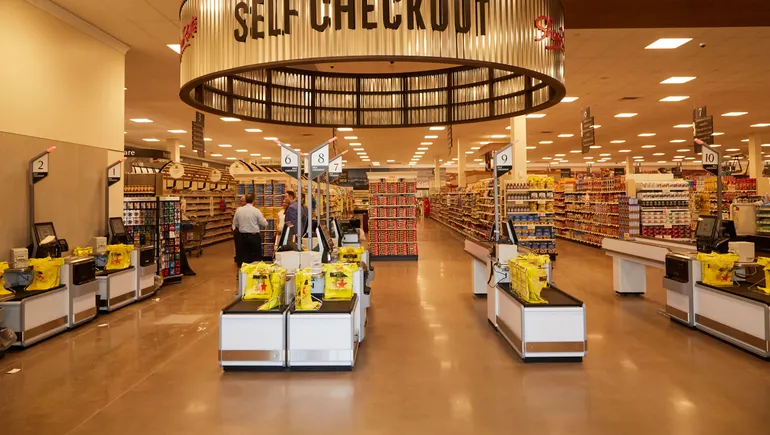
Since joining Walmart three years ago, Lovett said she has seen an increase in self-checkout and has witnessed the introduction of two robots into the store. The first assists with shelf scanning and restocking, which Lovett says can greatly help keep inventory and store counts accurate.
The second robot to arrive at Walmart was a floor cleaning robot, which Lovett says has replaced most of the employees previously responsible for that task.
According to the joint report, only 2% of surveyed workers reported having robots restocking shelves or providing services in the store. About 32% reported self-checkout kiosks, and 15% reported self-checkout apps. 60% of respondents said they use computer kiosks, iPads, or handheld devices to provide product information.
"What retail workers feel is that tasks, rather than entire jobs, are more likely to be replaced by technology."
— Maggie Corser, report author and senior research analyst at the Center for Popular Democracy
Undoubtedly, automation technology has entered grocery retail, but the speed of adoption and degree of deployment vary by company.
"I think companies have a choice to deploy technology in a way that automates work, or to reconfigure work in a way that supports employees and customers," Corser said.
Sajal Kohli, senior partner at McKinsey and leader of the Americas retail practice, told Grocery Dive that when organizations explore store automation, it is important for employers to be transparent.
"I would actually call it a basic requirement to have an open dialogue about this," Kohli said.
The importance of upskilling and cross-training
Beyond messaging, the presence of store automation requires employees to have new skills. Sources say how employers handle this transition is critical to their success and reputation among employees and the public.
"Some organizations basically just eliminate jobs and the people in them, and you will see some companies with mass layoffs," Sari Wilde, managing director of the HR business at Gartner, told Grocery Dive. "On the other hand, you will see some companies taking significant responsibility for retraining employees."
McKinsey's Kohli noted that training in grocery stores is not a new phenomenon. Companies have always developed training programs around the functional and technical nature of work, as well as for food safety purposes.
"I think the question is, have you built upskilling into it?" Kohli said, noting the importance of providing cross-training so employees can fill multiple roles, or upskilling them for new roles.
According to a recent McKinsey white paper, some companies say they are adopting automation slowly because they cannot find the talent they need. But the firm estimates that only half of the needed digital skills are available in the labor pool. While some employers may want to bring in new employees with digital and technical skills, McKinsey found that upskilling existing employees is more cost-effective. On average, the cost of upskilling an employee is 10% of their annual salary, while replacing an employee can cost 20% to 30%. McKinsey also found that providing upskilling to bridge skill gaps is necessary.
However, as retailers and other companies face numerous priorities, upskilling has not yet become a priority across industries. According to an Accenture survey of 1,200 executives,only 3% said they planto significantly increase training budgets in the next three years.
To date, Amazon is the only major retailer to announce a comprehensive investment in training to provide employees with digital workplace skills. The e-commerce giant plans to spend $700 million to upskill 100,000 employees. Some new skills support roles such asfloor control specialistwhich oversee robots.

Laura Strange, vice president of communications at the National Grocers Association (NGA), told Grocery Dive that many of its members are ensuring employees gain experience in multiple departments. She said training is not specifically focused on automation.
"Whether it's the front end, deli, management, or any other department, people are trying to cross-train and ensure employees get exposure and experience in different parts of the grocery store," Strange said.
NGA represents a group of independent grocery companies across the U.S. and provides its members with an online training platform containing over 170 grocery-specific courses. For example, someone can start a course, pause to go to work, and then continue during a lunch break or after hours. Strange said NGA regularly adds new courses based on member needs and requests.
Strange said that while automation in independent grocery stores may not be as widespread or fast-growing as in large retailers, it is still a disruptive force, and training remains a focus for independent merchants.
"Some organizations basically just eliminate jobs and the people in them, and you will see some companies with mass layoffs. On the other hand, you will see some companies taking significant responsibility for retraining employees."
— Sari Wilde, managing director of the HR business at Gartner
At Sam's Club, employees can use the newly launched interactive training experience "Fresh Learning Lab." Donath said the program is designed to train employees in fresh food departments, from meat cutters to cake decorators.
While the Fresh Learning Lab is not specifically focused on automation or technology, it aligns with Sam's Club's goal of teaching team members to work across departments.
"Employees are constantly learning how to perform new tasks and work in different areas," Donath said. "Overall, a lot of our training happens while employees are working on the sales floor. In addition to cross-training, employees can access most of our training tools through a mobile app."
At Groceryshop, Furner said Sam's Club sees that about two-thirds to three-quarters of employees asked to move to another role are willing to do so.
Incorporating employee voices
As automation replaces or redefines certain roles in grocery stores, experts say employers must listen to employee feedback and thoughts about the future. It is also important to understand each employee's expectations for their role and career development within the company.
"First, you have to stay connected with employees and understand the pulse of their career interests," Wilde said. "I think in some cases, organizations find that employees want entirely new career paths and want access to those types of opportunities. In other organizations, they may not be interested and may just want to go to another company that hasn't reached that stage of automation yet."
Wilde said Gartner's research finds that organizations ask employees which parts of their jobs could be automated. "Sometimes employees or their managers may know this better than leaders," she said.
Kohli said he does not believe all retailers truly value the need to involve employees and associates in the automation journey—but they should.
"Many of these associates will actually have great ideas about where automation potential could be beneficial or not," he said. "Engaging in dialogue with employees also helps organizations build a change management journey for those who may ultimately be affected."