
The Era of AI Shopping: Will Grocers Rely on Instacart?
AstraWorks reports that among 24 retailers, most connect to AI agents like ChatGPT through Instacart, but lack proprietary AI tools. Instacart's integration offers convenience but also raises trade-offs regarding control and data ownership. A few companies like Albertsons and Wegmans are building differentiated capabilities.
Quick Overview
- According to a report by AI-powered company AstraWorks, as more consumers use AI-assisted grocery shopping, many large retailers are relying on Instacart as a primary pathway to this rapidly evolving shopping capability.
- The company's AI Shopping Benchmark, based on observations of 24 retailers last month, found that most retailers lack proprietary AI shopping tools and have no direct connections to AI shopping agents like ChatGPT or Claude. Of the 18 grocers where shopping is possible via ChatGPT, 16 are connected through Instacart's integration.
- Despite Instacart's first-mover advantage, AstraWorks' report notes that retailers such as Albertsons and Wegmans are carving out unique AI shopping paths.
Deep Insights
Just as it did in e-commerce over a decade ago, Instacart has taken the lead in becoming a key service provider for grocers facing yet another potentially transformative shopping capability.
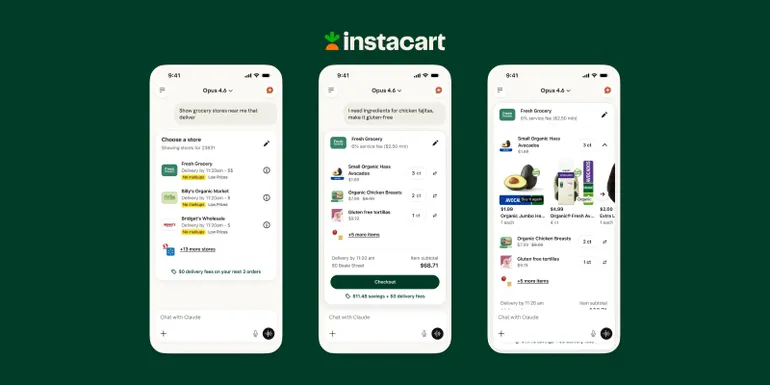
The grocery technology company launched its ChatGPT integration tool in December last year, and according to the report, for many retailers it represents the primary AI shopping capability available in the early stages of agentic commerce. AstraWorks' report lists 11 retailers, including Publix, Schnuck Markets, H-E-B, and Ahold Delhaize USA, as "platform-dependent" merchants in AI shopping capabilities.
"These retailers have little to no on-site capabilities, and most of their external agent presence is hosted by Instacart," the report states. "If Instacart integrations were removed, most of their agentic commerce scores would drop to near zero."
AstraWorks notes that such third-party integrations come with trade-offs for retailers.
"Retailers reaching AI shoppers through Instacart have a viable path to consumers, but have less control over the interface, intelligence layer, data capture, and long-term differentiation," the report says.
This dynamic echoes what grocers experienced as they increasingly relied on Instacart for online sales. Ultimately, many large retailers continue to depend on the technology provider—as well as competitors like DoorDash and Uber—while also building their own websites, pickup services, and other capabilities.
AstraWorks ranked the agentic AI shopping capabilities of 24 retailers based on factors such as whether they have proprietary AI shopping tools, the presence of AI shopping assistants on their websites and apps, and integrations with third-party AI agents like ChatGPT. Unsurprisingly, Amazon topped the list with a score of 63 out of 100, Walmart ranked second with 49, and Albertsons and Wegmans tied for third with 38. Most retailers scored between 10 and 24, and were rated by AstraWorks as "starters" in AI shopping.
Wegmans scored higher than many other grocers because it uses an AI assistant powered by Cooklist and also integrates Instacart's ChatGPT tool. Meanwhile, Albertsons built its own AI shopping assistant and established direct connections with Claude, Gemini, and Perplexity.
Notably, Whole Foods Market scored only 9 points, while discount retailers Trader Joe's, Dollar General, and WinCo Foods ranked at the bottom.
As grocers use AI as a tool for both shoppers and internal operations, they face difficult choices: whom to partner with and whether they can build capabilities in-house. Building proprietary tools is costly, but helps retailers control the experience and retain valuable data that can further advance AI capabilities; partnerships can help retailers get started quickly, but may mean losing control over valuable data.
"The trajectory of agentic commerce as a key shopping channel remains an open question in retail. Whether it stays primarily at the discovery level or rapidly generates a substantial share of automated transactions is an active debate," the report notes.