
The pandemic accelerates the deployment of unmanned delivery: from 'icing on the cake' to 'fuel in the snow'
Before the pandemic, autonomous grocery delivery was an 'icing on the cake' service for most consumers. During the pandemic, demand for contactless delivery surged, making the idea of robots delivering items like milk and eggs to the curb more appealing. Companies such as Nuro and Starship Technologies say their robots are operating at full capacity and are accelerating pilots and working with regulators to streamline processes. However, scaling the technology and achieving cost-effectiveness will still take time. This article reviews the progress and challenges of four companies—Nuro, Starship Technologies, Refraction AI, and Deuce Drone—during the pandemic.
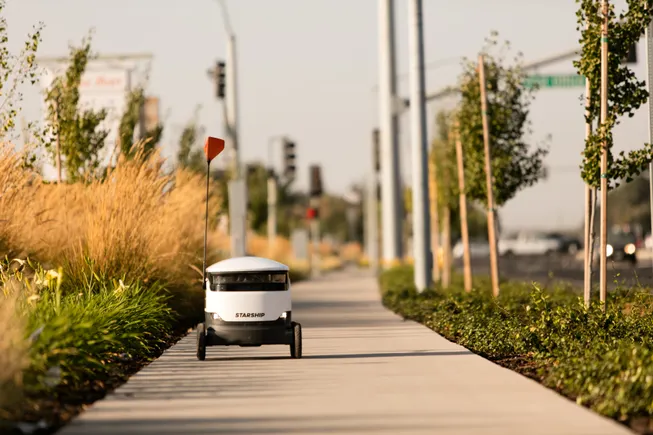
Before the outbreak, for most consumers, autonomous grocery delivery was more of a "nice-to-have" than an "essential" service. However, during the pandemic, consumer demand for delivery—especially contactless delivery—surged, making the idea of robots delivering milk, eggs, cereal, and other items to the curb suddenly highly attractive.
This means that consumer demand and the push to improve "last-mile" economics amid an unprecedented surge in online sales are jointly driving the development of autonomous delivery. Tech companies like Nuro and Starship Technologies say their robots are working overtime to deliver groceries and other goods. They are accelerating pilot project timelines, working with local and national regulators to streamline approval processes, and focusing on rapid innovation to adapt to the changing market.
"We're seeing grocery e-commerce double in some cases, and more than triple with Kroger," said David Estrada, Nuro's chief legal and policy officer. The company is currently running a pilot with Kroger in six ZIP codes in Houston.
Amazon and Walmart have both recently launched drone delivery programs, drawing more attention to this futuristic service that promises faster delivery and ultimately lower costs. But robot delivery has many limitations, including the areas where vehicles can operate and their maximum speeds.
"While robot sandwich delivery has become a reality in a few carefully selected ZIP codes with low traffic and well-maintained infrastructure, in many towns, delivery robots still face significant challenges in navigating safely," wrote a recent assessment in AutoWeek, an industry publication.
Autonomous delivery companies say the geographic range where their robots can operate is gradually expanding. However, company officials note that it will still take time for the technology to become scalable and cost-effective.
"For us, one of the key issues we've been pushing on is how to get the unit economics and price point of these vehicles low enough," said Matthew Johnson-Roberson, co-founder of Refraction AI. The company's vehicles are currently delivering groceries and restaurant meals in Michigan.
Here is a look at the progress four autonomous delivery companies have made during the pandemic and the challenges ahead.
Nuro
Headquarters: Mountain View, California
Retail partners: Kroger, Walmart, CVS
Top vehicle speed: 25 mph
In February, Nuro won a regulatory victory—the U.S. Department of Transportation approved its fully autonomous R2 vehicles on roads, the first such approval for an autonomous delivery vehicle. Estrada said the company is now in talks with regulators to raise the vehicles' current 25 mph top speed, which would allow them to operate on more roads.
Estrada said that in the February ruling and subsequent evaluations, the Department of Transportation recognized that delivery vehicles like the R2 do not need to meet traditional motor vehicle regulations. The R2 has no side mirrors, rearview mirror, or airbags.
Nuro had planned to launch the R2 in the spring, but delayed it as grocers were busy keeping shelves and warehouses stocked. Estrada said the company plans to launch the R2 this year in Houston with one of its partner companies (currently including Kroger, Walmart, CVS, and Domino's). He did not specify which company, but confirmed that Kroger, as previously announced, does plan to begin deliveries via the R2 in Houston.
Kroger partnered with Nuro in 2018, initially offering delivery in Arizona using manned R1 vehicles. The pilot moved to Houston last year, and Kroger customers in six ZIP codes are now receiving grocery deliveries via manned Toyota Prius vehicles using R2 technology.
Estrada said the significant increase in delivery volume this year has allowed Nuro to optimize its technology. He noted that as Kroger customers become accustomed to placing orders, receiving text messages that their goods have arrived, and walking to the curb to pick them up, the "stickiness" of the service has increased.
"It's a new experience for people that takes time to get used to. Once they get used to it, it becomes a habit," Estrada said.
Nuro is currently developing its next-generation autonomous vehicle (tentatively called the R3), which Estrada said will eventually become the company's fully scalable, mainstream delivery vehicle. Nuro received nearly $1 billion in investment from SoftBank last year, and the company also positions its robotic vehicles as a service solution for "food desert" areas, noting that these vehicles can serve markets that cannot support full-service stores at lower operating costs.
"We're having these conversations with partners and will increasingly focus on this," Estrada said. "It's a problem they've always wanted to solve but haven't found a good solution for, and now we're offering a better one."
Starship Technologies
Headquarters: San Francisco
U.S. retail partner: Save Mart
Top vehicle speed: 4 mph
Before the pandemic, Starship's sidewalk-roaming robots were primarily used on U.S. college campuses to deliver meals to students. After schools closed, Starship shifted its focus to grocery delivery, which it mainly conducts overseas.
Ryan Tuohy, senior vice president of business development at Starship, said that this spring in the UK, its service outside London expanded rapidly, adding several grocery stores each week. Within a few months, the service added 50,000 households, added Tesco and Budgens alongside its initial partner Coop, and completed hundreds of thousands of orders, thereby improving its delivery intelligence.
Last month, Starship signed its first partnership agreement with U.S. grocer Save Mart, which will offer delivery from its flagship store in Modesto, California.
Starship's robots travel at just 4 mph, which may sound too slow for the fast pace of online grocery fulfillment. But Tuohy said that since shoppers typically live within a few miles of their preferred grocery store, these robots can handle most two-hour or even one-hour deliveries. Although each vehicle can only carry two to three bags of groceries—which seems small at a time when stock-up shopping has become the norm—he noted that a significant portion of customers order through the service two to three times a week.
Starship operates through its own app and marketplace, depending on the region, covering grocers and restaurants. Tuohy said this is the company's preferred way of working with grocers, but it is open to other partnership models.
"Having a network with different options in the app creates a network effect," he said. "Time will tell how our partnerships evolve, but I strongly believe in the value of the marketplace."
Starship currently operates 1,000 robots globally, and Tuohy said the company is rapidly increasing that number. The company is also continuously improving the AI capabilities of its vehicles. More than 90% of the robots' movements are autonomous, but remote human operators handle complex scenarios such as busy intersections and construction zones.
"We've crossed streets autonomously over 5 million times, and most of the time it's autonomous, but certain traffic conditions trigger the robot to request permission for a specific crossing," he said.
Refraction AI
Headquarters: Ann Arbor, Michigan
U.S. retail partner: The Produce Station
Top vehicle speed: 15 mph
The pandemic brought two major benefits to Michigan-based Refraction AI this spring. One was a significant increase in order volume from the few restaurants and independent grocers that the company's bicycle-sized robots handle deliveries for. The other was a dramatic reduction in vehicles on the road.
"The roads became a huge testing ground, and we could push the limits more boldly while testing our vehicles," Johnson-Roberson said. "We got a lot of training data."
Johnson-Roberson founded Refraction AI in Ann Arbor last year after working at the University of Michigan. Despite snowy winters, the city's grid-like road system and large university population make it an ideal place to test autonomous delivery. The company started with deliveries from a few restaurants and then added service for local grocer The Produce Station.
Refraction's autonomous REV-1 robot is about 4 feet tall, can carry up to six bags of groceries, and charges a flat delivery fee of $7.50, quickly becoming a valuable assistant for the grocer. "Order frequency has risen significantly," Johnson-Roberson said. Confident the growth was not a flash in the pan, Refraction quickly built more robots, expanding its fleet from 10 to 25 units by the end of last month.
The REV-1 is legally classified as an electric bicycle and is equipped with 12 sensor cameras, allowing it to deliver in snow and rain. The $7.50 fee is charged to the merchant, who can choose to absorb it entirely or pass some of the cost on to customers.
Currently, Johnson-Roberson is focused on expansion. He has been in talks with local grocery chains and recently established a REV-1 hub on the west side of town, where many grocery stores are located. Refraction vehicles dock at the hub and can travel up to 3.5 miles in any direction. The company is also exploring expansion to other Michigan cities and neighboring Ohio.
Johnson-Roberson said retailers initially seemed "skeptical" about robot delivery, but as the pandemic has persisted, they have gradually embraced the technology. He said many retailers are adding dedicated fulfillment space in stores to more easily interface with autonomous vehicles. He also said grocers are interested in handling more of the picking process themselves and reducing delivery costs.
But Johnson-Roberson acknowledged that his company and other autonomous vehicle firms face the serious challenge of scaling in a cost-effective manner. He estimates that most robot delivery vehicles cost between $50,000 and $250,000 to build and said he hopes to bring the total cost per vehicle down to around $5,000.
Deuce Drone
Headquarters: Mobile, Alabama
U.S. retail partner: Rouses Markets
Top vehicle speed: Over 30 mph
Similar to Refraction AI, Deuce Drone has benefited from the increase in open space during the pandemic. After the University of South Alabama closed in the spring, the Mobile-based company began using campus grounds to further test its 3-foot-wide quadcopter drone, which can carry up to 12 pounds of groceries and other goods.
"We no longer have to go out of our way to find empty, unoccupied spaces," said Rhett Ross, CEO of Deuce Drone.
This data will help Deuce Drone begin deliveries from Rouses grocery stores and local restaurants by the end of the year. The test plan includes five drones shuttling between participating locations (including a local Buffalo Wild Wings franchise) and consumer homes.
Shoppers must first be approved by Deuce Drone to ensure their homes have suitable landing space and no pets or children that could pose a safety hazard. Shoppers will place orders through the drone operator's app. Staff at each store will then pick the orders, pack them into special bags, and attach the bags to drones docked in dedicated landing bays before takeoff.
Each drone can fly up to four miles in any direction at speeds approaching 40 mph. Ross said this means aerial couriers can quickly cover longer distances, keeping hot food hot and cold items cold. He estimated that a distance a drone can cover in 6 minutes would take a vehicle 30 minutes.
Ross said the tests will help Deuce Drone optimize the order loading and unloading process. The company will also improve takeoff, landing, and flight capabilities and seek to expand the service to other retailers in the region.
Drone delivery has long been viewed as impractical, but recently, with technological advances and regulatory clearance from the Federal Aviation Administration (which has been issuing permits to companies like UPS and Wing Aviation since last year), the concept has begun to take off. Amazon and Walmart have both recently launched drone delivery services, including for grocery orders.
Ross believes consumer acceptance is equally important. Alongside this year's drone delivery pilot, his company will hold educational events at Rouses stores and restaurants, where shoppers can see drone models up close and feel their carrying capacity.
"This helps them understand the opportunity and also allows them to ask the questions they want to ask," Ross said. "We want them to be prepared so there are fewer surprises when the service launches."


