
Heinen's Introduces Salad Robot Sally in Response to Self-Service Bar Closures During Pandemic
During the pandemic, after closing its self-service salad bars, Heinen's introduced Sally, a robot from Chowbotics, to provide contactless salad preparation services. Sally stands 6 feet tall, weighs 750 pounds, holds 22 ingredients, and costs $7 per salad. The company plans to test its efficiency and customer acceptance; if successful, it will be expanded to all stores and may permanently replace traditional salad bars.
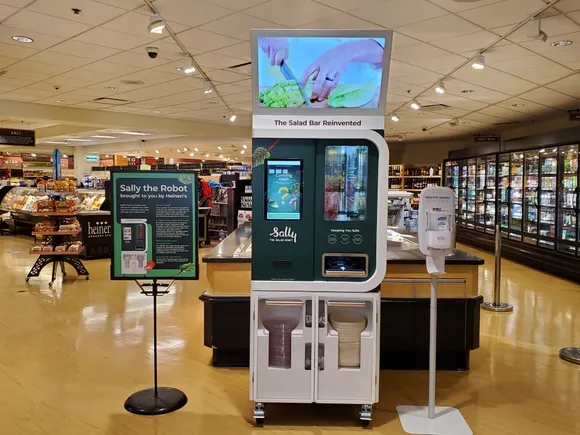
The pandemic forced Heinen's to close its self-serve salad bars in March, a heavy blow to a grocery chain known for its prepared foods. Rather than wait for local officials to approve resuming service—which could take months—Heinen's decided to try something new.
It brought in Sally.
Sally is 6 feet tall, weighs 750 pounds, and is a salad-making robot that delivers Caesar salads, Cobb salads, and other preset options, as well as custom mixes, with a few touches on a digital screen. The device, developed by San Francisco tech company Chowbotics, can hold up to 22 fresh ingredients, including liquids, grains, and proteins such as chicken, brisket, and salmon, all prepared and loaded on-site by Heinen's employees. After customers enter their choices, the machine drops fresh vegetables, lettuce, and other toppings, along with dressing, into a compostable bowl.
Heinen's introduced Sally to customers on Friday at its store in Pepper Pike, Ohio, a few miles from its corporate office. The green-and-white machine appeared at the end of the store's salad bar area, which is now stocked with drinks and packaged salads and sides, creating a contactless dining zone. Heinen's has programmed the system with five standard salad options and a custom option, all priced at $7, and plans to add more mix-and-match choices as customers become familiar with the operation.
Later this month, Chowbotics will launch an app that lets customers place orders and receive a QR code to scan at the machine, enabling fully contactless salad preparation.
Chris Foltz, Heinen's chief innovation officer, said customers have missed the experience of customizing meals at the company's food service counters. Sally offers a way to do that, while its 18 packaged salads, which have seen significant sales growth during the pandemic, serve as a grab-and-go option.
If the rollout goes well, Sally could eventually replace Heinen's self-serve salad bars, Foltz said. Sales in that department have been declining for years—a trend occurring nationwide. According to Nielsen data, salad bar sales fell 6.5% last year compared with 2018.
Even after the pandemic ends, customers are unlikely to rush back to an area requiring shared utensils and shoulder-to-shoulder self-service.
"Who knows when we'll be able to reopen the salad bar, and even if we do, how much interest will there be?" Foltz told Grocery Dive.
Before the pandemic, grocery stores were not a focus for Chowbotics, said Mara Behrens, vice president of design and marketing. But now, interest from retailers trying to replace salad bars has increased significantly, even if only temporarily. The company will soon work with three large retailers, whose names Behrens declined to disclose, and with other smaller grocers in the coming weeks.
"We've really focused on the grocery space recently," she told Grocery Dive. "The demand has been pretty amazing."
A savior for the salad bar?
Could Sally be a lifeline for grocers hurt by the closure of salad bars?
To be sure, retailers are eager to boost sluggish prepared food sales and inject life into store sections that had to be closed during the pandemic. Many retailers have kept salad bars closed and piled everything from packaged meals tobottled alcoholon top of them. Others, like Publix and Whole Foods, have turned them into full-service operations, while some, like Balls Foods, havebegun reopening self-serve salad bars with multiple safety measures。
According to Nielsen data, salad bar sales have fallen nearly 54% so far this year. In the week ending mid-June, sales in the department were down 95.5% from the same period last year.
At Heinen's, Sally can produce only about a quarter of the 150 salads the store typically sells during a lunch period per hour. But the machine dispenses ingredients by portion, reducing waste. It can also charge extra for premium ingredients, allowing retailers to offer items like salmon and lobster that a traditional salad bar cannot.
Sally is also fully connected. It provides retailers with customer data, letting them know which ingredients sell best and at what times. Whenever one of the machine's ingredient canisters is about to run out, it sends a text message to store employees.
Sally is more than just a salad-making machine, Behrens noted. It can dispense yogurt and custom grain bowls. It is automating the process of mixing and matching fresh, popular ingredients that have made chains like Chipotle and Sweetgreen popular.

And Sally is not the only robotic meal-making device on the market. Over the past few years, so-called "smart" vending machines capable of dispensing everything from hot pizza to ramen bowls have begun appearing in airports, universities, and corporate offices. With many of those locations closed or seeing sharply lower foot traffic, some machine makers are turning their attention to grocery stores.
Advanced vending machines from companies like Basil Street Pizza and Yo-Kai Express—the latter can dispense a hot ramen bowl in 45 seconds—are a far cry from the monotonous spiral-coil machines long defined in consumers' minds, said Chris Albrecht, editor-in-chief of food tech site The Spoon.
Albrecht predicts the next generation of machineswill appear in more public and private spaces in the coming years, and many consumers will try the technology.
"Smart vending machines are seeing new opportunities, and I think some of those new opportunities will be driven by people paying attention not just to where food comes from, but also to how many people have touched it," he told Grocery Dive.
Deglin Kenealy, CEO of Basil Street, said he has had more conversations with grocers recently but has not yet reached an agreement. The company expects to deploy up to 100 devices this year and possibly up to 5,000 over the next two years, primarily in hospitals, factories, and military bases.
"People have gotten used to using ATMs, DMV kiosks, and Coinstar machines," Kenealy told Grocery Dive. "So we're moving in that direction. I think grocery stores are starting to realize that it's hard to differentiate on groceries alone these days."
According to Nielsen data, salad bar sales have fallen nearly 54% so far this year. In the week ending mid-June, sales in the department were down 95.5% from the same period last year.

The automation revolution
Retailers are beginning to incorporate automation into their operations, fromrobotic online fulfillmenttofloor-cleaning machines. Last year, Stop & Shopdeployed a bread-making robotat a store in Milford, Massachusetts. Automation promises to save labor, increase speed and precision, but labor advocates argue that robots will eliminatehundreds of thousands of jobs。
Advanced vending machines could be a logical next step in this automation revolution. However, they may not be a fit for grocers that still sell brick-oven pizza, artisan sandwiches, and grab-and-go soups, Albrecht said. The machines also have to make economic sense. They cannot handle the same volume of food as a food service counter, and they often require companies to go through a learning curve. They also must sell enough product to scale and recoup upfront costs—in Chowbotics' case, $35,000 per unit.
"[Grocers] need not just good ideas, but things that can be implemented at scale immediately," Albrecht said.
It remains unclear how or where smart vending machines will fit into store operations once grocers can bring back food service counters and restaurants. Can Sally and the salad bar learn to coexist?

Foltz said the pandemic was not the reason he initially became interested in Sally. When he first evaluated the machine before the pandemic, he did not see its value for Heinen's stores.
"I thought, 'What can it really do?'" he said. "[Customers] already get custom salads from the salad bar and grab-and-go from packaged salads—so what can it really do in a grocery environment?"
But he did see a use for the salad robot in the company's upcoming health platform, Fx. The program,announced last yearand slated to launch later this year, will provide customers with food prescriptions and nutrition counseling. Enrollees will be able to choose special salads and grain bowls available through Sally that align with their prescriptions.
Fx will also be offered to employers, meaning Heinen's-branded Sally machines could soon appear in office buildings, factories, and other locations.
Four months into the global pandemic, Foltz said Sally also makes sense as an in-store solution in the absence of good alternatives. To help customers operate the machine, Heinen's placed instructional signs next to it and scheduled employees to be on hand during peak hours. To attract customers, the company sent emails to those who had used the salad bar in the past.
Foltz said he hopes to see Sally in every Heinen's store soon.
"What we need to prove is, how many customers can it serve per hour? Can customers adapt quickly?" Foltz said. "If we can prove those things, we'll roll it out quickly."
Correction: A previous version of this article incorrectly stated one of the items the Sally robot can offer. The machine only dispenses refrigerated items, not hot food.