
Supermarket operators reassess the future of self-service buffet counters: restart, remodel, or permanent transformation?
Under the impact of the pandemic, supermarket self-service buffet counter sales plummeted by 30%-40%. Operators are weighing restarting, remodeling, or permanent transformation, and trying alternatives such as packaged food displays and staff service, but hygiene regulations and consumer confidence remain key variables.
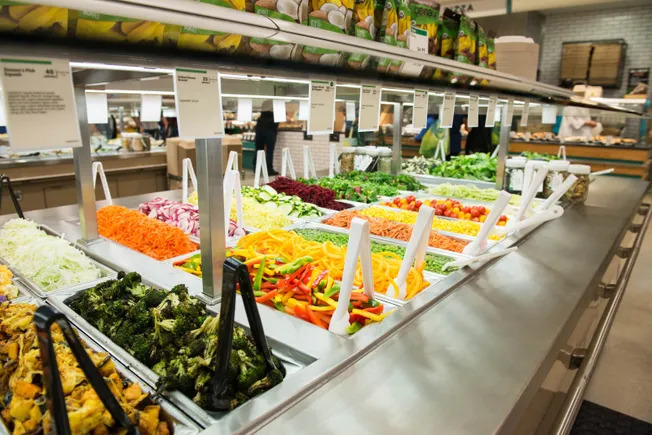
The pandemic forced supermarkets to hastily abandon their self-serve deli operations developed over many years, and now they are beginning to study strategies for how to make these facilities profitable again.
However, according to retailers, consultants, and other experts interviewed by Grocery Dive, as operators look for ways to bring idle salad bars, hot food counters, and other self-serve stations back into sales mode, they face a series of logistical and marketing challenges that require creativity and perseverance to overcome.
"Supermarkets invested 70 to 200 feet of self-serve space in their stores, and now they're all asking: 'What do we do? How do we handle this space?'" Steve Petusevsky, a foodservice consultant and former culinary innovation director at Whole Foods, told Grocery Dive.
Compared with surging sales in the center store, fresh produce, and protein categories, deli sales have fallen 30% to 40% since the COVID-19 outbreak, Petusevsky said. Sales are improving as shoppers re-enter stores. According to IRI data, deli prepared food sales fell 47% in mid-April but recovered to a 27% decline in the last week of May.
Supermarkets now face a difficult choice: whether to try to reopen these once-profitable facilities, repurpose them for other uses, or possibly change them permanently. Companies like PCC Community Markets in Seattle are still waiting for guidance from local health officials on when they can reopen self-serve stations—or what that will specifically look like.
Meanwhile, the 14-store specialty chain has placed packaged meals for 2 to 4 people on its salad bar and hot food bar counters.
"On any given day before the pandemic, our hot food bar might have had up to 16 different items. Now, we might have six, and they're all packaged," Tracy Marik, PCC's senior deli merchandise manager, told Grocery Dive.
In the Midwest, Balls Food Stores, which operates 27 stores in Kansas and Missouri under the Hen House, Price Chopper, Sun Fresh, and PayLess banners, reopened salad bars at six supermarkets on Monday, but with numerous restrictions, said Mike Tilden, the grocer's deli and bakery director.

Courtesy of Balls Food Stores
At each location, when the salad bar is open, an employee continuously monitors and cleans it, and customers must use hand sanitizer and wear gloves to serve themselves, Tilden said. Staff provide utensils to customers and replace them hourly. He added that due to these adjustments, the salad bar's operating hours are shorter than before the pandemic.
Balls Food Stores hopes to restore self-serve operations at more locations when conditions allow, Tilden said.
"We want to get back to normal as much as possible, using the counters they're used to seeing and shopping from," he told Grocery Dive. "I think we've taken the right measures to protect our customers and associates."
Self-serve, full-service, or no service?
Supermarkets have been so busy keeping shelves stocked, staffed, and e-commerce operations running that deciding the fate of self-serve stations hasn't been a top priority. Sources say that now restaurants are reopening and consumers are visiting stores more frequently, supermarkets know they need to take the next step with their stations.
"I don't know how much longer they can wait and continue to see double-digit declines in their foodservice business," said Francie Dannemiller Jenks, business development manager at Hussmann, which supplies service station equipment to food retailers.
Demand for pre-packaged salads and other ready-to-eat foods, as well as meal kits, is strong, making these items a natural fit for merchandising in and around self-serve stations, Jenks said.

Hussmann has been in discussions with supermarkets about how to temporarily retrofit salad bars and other equipment to display pre-packaged foods so customers can see them from a distance. Even just elevating items and keeping them angled outward can make a significant difference, said Ryan Petrick, another business development manager at Hussmann.
But many salad bars and hot food counters have been sitting idle in prominent locations, posing a challenge for retailers hoping to bring them back to life. Retailers "have spent the last four months training people that there's nothing in the bar, so they have no reason to walk over," Petrick said.
The problem is compounded because salad bars typically have large surface areas that require repeated cleaning. These stations may also deter shoppers worried about contracting COVID-19 through inadvertent contact, Petrick said.
Petusevsky said he believes the most practical use for salad bars right now is as display cases for packaged foods. "It's really a necessity until (supermarkets) figure it out," he said. "It's a short-term solution, but the short term will be longer than we think."
Packaged comfort foods like macaroni and cheese, lasagna, and slices of cake seem particularly popular right now, Petusevsky said. Many retailers, like PCC, are packaging multi-serving meals, appealing to shoppers who are eating more at home with their families.
"Customer visits are down, and if you think about what that means, it's that shoppers are doing more stock-up trips and are less interested in single-serve items," Marik said.
"It's an extremely multifaceted and difficult puzzle, not driven by retailers. It's driven by consumers and where their confidence is, and that's the difficulty."
Anne-Marie Roerink
President of 210 Analytics
However, a growing number of retailers are not content to use service stations as display cases and are instead converting them into full-service stations. According to CNBC, Publix has reopened salad bars with employees distributing ingredients, while Wegmans has moved hummus and olives behind service counters.
Moving to full service may require equipment upgrades. Hussmann has designed sliding doors that can be installed on existing equipment for employees to use for serving or self-service, Jenks said. Petusevsky said he has seen retailers retrofit sneeze guards on self-serve stations and add plexiglass barriers so employees can serve shoppers cafeteria-style.
Restoring momentum in foodservice is crucial because the industry views the department as a differentiator, said Anne-Marie Roerink, president of 210 Analytics, a research firm specializing in the food retail industry.
Now that shoppers are more concerned with getting in and out of stores quickly, and many consumers are turning to options like delivery and curbside pickup that avoid entering stores altogether, retailers have to confront issues not entirely within their control, Roerink said. Even if retailers are legally able to restore salad bars and hot food counters, there's no guarantee customers will feel safe enough to patronize the department.
"It's an extremely multifaceted and difficult puzzle, not driven by retailers," Roerink said. "It's driven by consumers and where their confidence is, and that's the difficulty."
Will customers return to self-service?
Some supermarkets have decided they can't wait any longer and are determined to at least partially restore the self-serve experience. In Houston, a local TV station recently reported that a Kroger store reopened its salad bar in violation of health department guidelines. The company told the station it was beginning to test reopening salad bars, while county health inspectors said supermarkets could only reopen stations where food is distributed by "trained food handlers."
Local regulations are equally instructive and frustrating for other retailers. In King and Snohomish counties in Washington, where PCC stores are located, health department officials have suggested that company employees must carefully "monitor" self-serve stations, but so far have not issued detailed reopening guidelines, Marik said.
"That's one of the terms we've heard, and we're like, 'Okay, what does that even mean?' Does it mean someone is looking at it? Or does it mean someone is stationed at that station?" he said. "We're not clear, and I guess they're not either. We're all experiencing this for the first time."
Marik said he relies on local health officials as well as other retailers, trade groups, and the National Cooperative Grocers Association for guidance and to share best practices.
"At the end of the day, if there's any safety concern, (self-service) won't come back," he said.
Balls Food Stores' Tilden said he believes now is the right time to reintroduce self-service, but emphasized that the company has made compliance with health department regulations a top priority. He noted that the process is complicated by varying requirements across jurisdictions.
"We want to be respectful and do the right thing," Tilden said. "Our top priority is safety."
Still, Tilden expects some shoppers won't be convinced they can return to pre-pandemic ways.
"We do believe there will be customers who never return to the salad bar or any self-serve station, or even the deli area," he said. "That fear may not go away until there's a vaccine, and (for some) it still may not."
Balls is also reopening seating areas in its stores, Tilden said. But with people staying home, the lunch crowd that drives prepared food sales remains elusive.

Balls and Kroger are not the only retailers trying to partially restore self-serve food stations. Pizza Inn, a chain with 85 buffet restaurants, is also allowing customers to serve themselves in areas where health authorities permit it. Last month, the company issued a detailed announcement outlining its new safety-focused "Right-Way Buffet."
"This is a significant part of our revenue stream. We don't feel we're in a position to give up on restoring self-service," Justin Smith, director of operations at Pizza Inn, said in an interview. "For the most part, our customers seem grateful that we're open and happy to get out of the house."
Most Pizza Inn locations have adopted a back-of-house buffet system where employees serve customers cafeteria-style. "Most operators are trying to have someone serve the guests. We've set up social distancing guidelines. They approach the buffet, and then the guest tells us what they want, and we serve them. It's the simplest way," Smith said.
One advantage for Pizza Inn is that many locations had moved buffet service to the perimeter of the dining area before the pandemic, making it easier for employees to serve customers from one side. Smith said locations with island-style buffets (the kind many supermarkets use) are harder to manage.
"When it's a single-sided buffet, it's easier to manage where they start and stop and what they can touch," he explained. "When it's in the middle, it's a bit of a free-for-all."
To better manage customer flow, Pizza Inn provides floor arrows and signage directing customers one way through the buffet.
"We want to get back to normal as much as possible, using the counters they're used to seeing and shopping from. I think we've taken the right measures to protect our customers and associates."

Mike Tilden
Deli and Bakery Director at Balls Food Stores
At PCC, prepared food sales are improving even without self-service, Marik said. Stations offering fresh pizza and cookies remain popular, and traffic is now increasing at its taco shop and coffee bar. But most locations in bustling neighborhoods, accustomed to bustling lunch and dinner business, have lost a key part of their identity, Marik said.
PCC is also in a bind because it tries to minimize packaging, but now has no choice but to package items previously offered in bulk.
"Every cookie, every pastry, every little donut (has to be packaged)... This is so contrary to how PCC has operated for years," Marik said. "COVID has forced us to shift a bit to provide a level of consumer protection while still keeping the items customers love in the store."
Regardless of where retailers stand on reopening self-serve stations, Petusevsky said it's important that they emphasize their commitment to safety in how they present themselves to consumers.
"You have to ask, what are consumers looking for now post-pandemic? The short answer is safety, and assurance that the food they're getting has been handled as little as possible," he said. "I think this will last a long time... like air travel. I don't think it will change until there's a treatment or a vaccine."