
The Key to Successful In-Store Farms: Finding the Balance
To meet consumer demand for transparency in food sourcing, U.S. retailers such as Kroger and Whole Foods are beginning to introduce high-tech farms in-store. However, experts point out that operating a micro-farm is not easy, requiring a balance between production efficiency and consumer appeal. This article analyzes the practices of companies like InFarm and Smallhold, as well as Cornell professor Neil Mattson's questions about cost and scale.
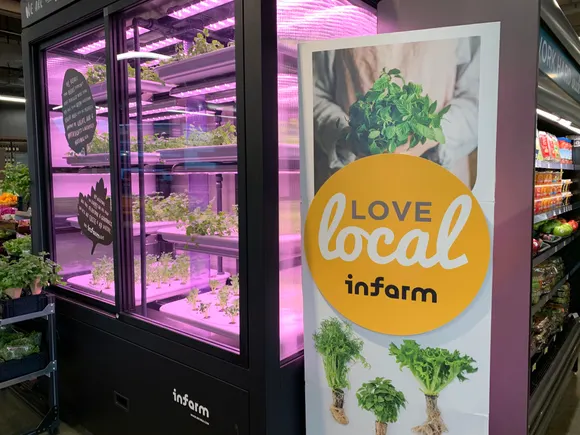
To cater to consumers' growing demand for transparency and their desire to know where their food comes from, retailers across the country have brought local products to their shelves. They have also created informational web pages, integrated with nutrition apps, and encouraged suppliers to tell customers the stories behind their products.
However,95% of consumerssay they are willing to pay a higher price for locally grown products, and 21% of consumers say they eat local food at least twice a week, putting pressure on businesses to invest more. Companies like Kroger and Whole Foods have taken this step, bringing high-tech produce farms into their stores—a growing movement made possible by advances in growing technology.
"Across the entire indoor farming industry, the cost of physical hardware, advanced LED lighting, and technology platforms for automated growing cycles has dropped significantly," Alexander Olesen, founder of automated micro-farm supplier Babylon Micro-Farms, told Grocery Dive.
As more retailers discuss moving core store operations online and strengthening the area around the store, micro-produce farms are expected to provide a supply chain while adding a food theater effect.
"We are also seeing that many traditional grocery items are being purchased online, which frees up a lot of space in stores," Olesen said.
Retailers have been bringing farming into their stores for years. As early as 2012,Rousesattempted to attract customers with an aeroponic garden on the roof of one of its New Orleans stores. Hy-Vee and H-E-B's Central Market stores have also tried growing operations, with the latter adding a 53-foot modified shipping container to one of its Dallas stores to grow leafy greens.
Whole Foods has established several different in-store growing operations. In 2018, itaddedan in-store mushroom growing display at its Bridgewater, New Jersey store. The system was provided by Smallhold, a Brooklyn-based indoor farming company that also sells its mushrooms to local restaurants. A few years earlier, the chain partnered with urban greenhouse operator Gotham Greens to open a growing facility on the roof of a Brooklyn store.

This trend is gaining momentum in Europe and Japan. Berlin-based InFarm, founded in 2013, has placed its in-store farms in hundreds of European stores, growing leafy greens, herbs, and vegetables, while Amazon Fresh sells its products in Germany, France, and Switzerland. Last year, the companyraised $100 million。
InFarm recentlymade its U.S. debut, launching in two Kroger-owned QFC stores in Seattle, and plans to bring its kale, mint, cilantro, and dill to 13 additional stores this year. The leafy greens are initially grown at a nearby distribution center and then transferred to stores, with each plant's growth monitored remotely by the company. The vegetables are competitively priced at $2.99 per bunch.
Grocery Dive contacted Kroger and Whole Foods for comment but did not receive a response by press time.
InFarm co-founder and Chief Marketing Officer Osnat Michaeli said InFarm has ambitious goals for its in-store farms, hoping to significantly impact grocery and restaurant supply chains.
"By growing produce near the point of demand, retailers can reduce the food waste and sunk costs typically associated with industrial agriculture," Michaeli wrote in an email to Grocery Dive. "We find that when retailers can understand the value, quality, and flexibility of our business model, they are more willing to enter the conversation and explore our farms."
Retail attraction or real action?
Although in-store farm displays and gardens are attractive additions, farming is by no means easy, even on a micro scale.
"I think this trend will be closer to food theater, closer to a niche that attracts the public and gets them excited about fresh produce," Neil Mattson, associate professor at Cornell University's School of Integrative Plant Science, told Grocery Dive. Mattson's research focuses on controlled environment agriculture systems such as hydroponics.
He added that operating an in-store farm is not for beginners; retailers or their agricultural partners must allocate staff to monitor the in-store farm to ensure it runs properly. This requires intensive training, adds labor hours, and may prevent employees from completing other tasks that still need to be done.
Mattson said that if an in-store farm is not run properly, plants can suffer from unsightly mold, disease, and other issues, making the display unattractive to shoppers. If this happens, the plants must be removed immediately and all surfaces disinfected, leaving an empty display.
Even for high-tech farming systems monitored remotely, Mattson expressed concerns about their long-term success.
"Plants are biological systems; sometimes they don't grow as fast as expected, or some other factor becomes a limiting factor, and you have to adjust," he explained.
Mattson also questioned whether in-store farms can supply enough produce to be more than just an interesting display for consumers. Total U.S. produce sales in 2018 amounted to$60.8 billion, up 1.7% from the previous year. The input costs of indoor farming systems—water and electricity for 24/7 LED lights—are significant hurdles even for large-scale indoor growing operations.
"It's hard to see how this can produce enough produce at the required price point to become the mainstream way most Americans buy lettuce," Mattson said. "I think it's an expensive way to grow produce in a supermarket."
In the past, high-tech farming operations have struggled to overcome high costs, but a new generation of companies like InFarm and Babylon claims their systems are more cost-effective and scalable.
Mattson said that if retailers can overcome these challenges, the benefits of in-store farms would include cutting out distributors and other middlemen (who often mark up produce prices) and increasing store traffic. He believes the success of in-store farms may depend on balancing production efficiency and effectiveness with the desire to entertain consumers.
Mattson said that larger-scale operations, like Whole Foods' rooftop farm in Brooklyn, offer the dual benefits of attracting customers and providing a more viable supply chain. In recent years, retailers have also turned to large greenhouses and vertical farms to supply stores. Gotham Greens operates greenhouses in five states, while BrightFarms operates greenhouses in four states and supplies retailers such as Giant Food, Acme, and Food Lion.
Finding a middle ground
For Smallhold, a Brooklyn-based grower and Whole Foods partner, offering mushrooms first and then in-store farms has been the recipe for success. The business's two founders initially supplied locally grown mushrooms to restaurants from a shipping container. They began asking buyers if they could install a mini mushroom farm on-site, and, encouraged by the response, started modeling prototypes.
According to co-founder Adam DeMartino, Whole Foods local buyer Elly Truesdell was dining at a Vietnamese restaurant that had a Smallhold mushroom farm, and she immediately contacted the company to explore setting one up in a Whole Foods store.
"We didn't set out to create a produce brand; it just happened naturally, largely because of Whole Foods," DeMartino told Grocery Dive.
Today, Smallhold maintains mini mushroom farms in restaurants and retail locations, including two Whole Foods stores. It also sells mushrooms under its own brand.
Smallhold visits each retail location with a mini farm once a week to replace materials and harvest mushrooms. To meet the yields required by retailers like Whole Foods, the company breaks down the growing process, completing the final stage (fruiting) in-store. DeMartino said mushrooms have an advantage over other indoor-grown crops because they typically produce high yields per square foot.
"Is it for everyone? I'm not sure. That's why this isn't the only thing we do," co-founder Andrew Carter added. "Our view is that we provide a variety of different tools to accomplish the task of getting mushrooms to everyone in America and around the world. One of those tools is increasing the visibility of agriculture through on-site growing."