
The New Landscape of In-Store Dining: The Future of Food Halls, Ghost Kitchens, and Supermarket Dining
As pandemic restrictions ease, U.S. supermarkets are intensifying their focus on in-store dining with unprecedented vigor, including new formats such as food halls and ghost kitchens. Design firm Shook Kelley notes that 85% to 90% of its newly designed stores will incorporate dining concepts. Retailers aim to extend customer dwell time and increase overall sales through dining, while also preparing more flexible operational spaces for potential pandemic resurgences.
When Lucky California was promoting its new flagship store in California, the focus was not on packaged food or online shopping, but on The Eatery, a new takeout restaurant where customers can order a variety of fresh dishes, and The Drinkery, where bartenders serve a range of alcoholic and non-alcoholic beverages.
Earlier this month, customers stepping into the 50,000-square-foot store were invited to purchase a meal or a drink, or both, and then head to the outdoor patio to dine. The store also features other "immersive" experiences, such as live cooking demonstrations and areas where customers can customize party cheese platters and nachos.
More than a year ago, the COVID-19 pandemic forced supermarkets to close in-store restaurants and bars that had added a "wow" factor to their locations. Now, supermarkets are eager to fully return to normal. Despite lingering safety concerns, a rising trend of home cooking, and other factors, supermarkets are embracing foodservice more aggressively than ever.

Kevin Kelley, principal and co-founder of the design firm Shook Kelley, said he is working on more in-store restaurant projects than ever before. He estimates that 85% to 90% of the stores his firm designs and plans to open in the next two to three years will include a restaurant, bar, food hall, or another form of foodservice concept. Most of the supermarkets he works with want to create dine-in venues, reflecting their belief that the longer customers stay in the store, the more they spend.
Kelley attributes the surge in demand for in-store dining to several factors, including the need for supermarkets to better compete with independent restaurants and an influx of investment capital retailers gained in 2020. Supermarkets also realize that, although foodservice was popular during the global health crisis, they still need to make their stores more attractive places to shop.
"They're trying to figure out how to attract customers and further distance themselves from the commodity business," Kelley said.
Because restaurant operations are complex and costly, they often struggle to generate significant profits for retailers, Kelley noted. Supermarkets need foodservice venues to attract new customers and drive sales growth in other parts of the store. "A single restaurant can lift overall store sales by 20% to 25%," he said, "but only if that restaurant is good enough."
Upscale California chain Gelson's had to close all of its tapas bars and sushi restaurants when the pandemic hit and has not yet reopened them, said John Bagan, chief merchandising officer. The company responded by offering special takeout online meals and hosting virtual tasting events, such as one recently hosted by "Breaking Bad" stars Bryan Cranston and Aaron Paul for their tequila brand.
This has not dampened the supermarket's positive outlook for in-store dining. Bagan said Gelson's plans to add two new tapas restaurants and one sushi and seafood restaurant by the end of this year.
"As everything begins to reopen, customers seem very eager to enjoy our wine and tapas bars again and return to those face-to-face experiences," Bagan wrote in an email, noting that the company plans to soon open bars with outdoor seating.

Aaron Ruef, project director at Cincinnati-based design firm FRCH Nelson, said the firm has worked with restaurant operators and Kroger. He noted that supermarkets are partnering with local restaurants to enhance the community hub feel of their stores. Kelley echoed this trend, pointing out that smaller restaurant operators often find it easier to work with supermarkets than large chains.
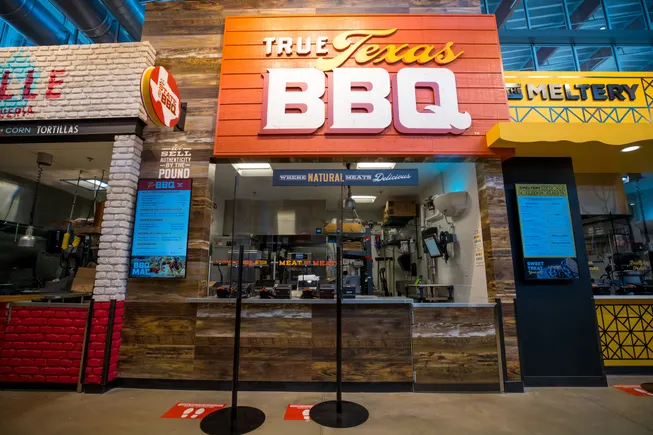
Ruef and Kelley both said one manifestation of this trend is the food hall concept—bringing multiple restaurants, often local or regional favorites, into the store. Giant's new flagship store in Philadelphia features a food hall with local chains Mission Taqueria and Saladworks. H-E-B's food hall in Austin, Texas, includes five restaurants and a full-service bar. The dining area at Kroger's Cincinnati flagship houses local operators such as Eli's BBQ and Queen City Whip. Schnuck Markets plans to add a food hall with three local restaurants in its renovated store in Kirkwood, Missouri.
Food halls have the appeal of becoming community gathering points, catering to a broad range of customers. But Kelley warned that too many food halls in a community could diminish their novelty.
"A city of a million people can support two to four food halls, but it can't support twenty," he said.
Even as they go all-in on experiential formats, supermarkets still want to be better prepared for a pandemic resurgence or other global health crises. Kelley said supermarkets are asking for more "flexible" designs so they can quickly convert restaurants into e-commerce fulfillment zones and foodservice areas into merchandise display areas. Monica Cole, who leads Wells Fargo's food, beverage, and agribusiness division, said the restaurant and retail operators she works with are focused on providing socially distanced seating and building outdoor dining spaces where possible—two safety measures she believes can also be applied to in-store dining venues.
"A single restaurant can lift overall store sales by 20% to 25%. But only if that restaurant is good enough."

Kevin Kelley
Co-founder and principal of Shook Kelley
Walmart's restaurant transformation
One retailer making major changes to its in-store restaurant strategy is Walmart, which rents out space in its stores to operators. In April, news emerged that hundreds of McDonald's locations were exiting Walmart due to poor sales during the pandemic, marking a sharp decline in the decades-long partnership between the two giants. Meanwhile, Walmart has begun bringing in new restaurant brands, such as Texas-based bakery chain La Madeleine and Ohio-based Charleys Philly Steaks, signaling a greater focus on regional brands.
Darryl Spinks, Walmart's director of retail services, said the retailer is increasing its outreach to local and regional restaurant operators. He described the move as responding to changing consumer tastes rather than filling leasing vacancies.
"We're doing a lot of work to make those tenants more aware of the space we have available in their communities," he said.

Spinks also said Walmart will be more "intentional" in choosing restaurant tenants that match the surrounding community. In addition to adding local operators, Walmart recently welcomed new locations of Domino's and Taco Bell.
"If there are already four burger places around the parking lot, would we add a fifth inside the store? Probably not," Spinks said.
Walmart is also staking a claim on the digital frontier by introducing ghost kitchens, which prepare meals for popular brands like Quiznos, Saladworks, and Nathan's Famous for online ordering or in-store pickup. This model has also been adopted by Kroger, borrowing from popular restaurant strategies that allow operators to mass-produce takeout meals in dedicated prep spaces.
To deploy these next-generation spaces, Walmart has partnered with companies like Ghost Kitchen Brands. Marc Choy, president of Ghost Kitchen Brands, said the company is building ghost kitchens in 29 Walmart stores across the U.S. These locations typically have two to three employees and focus on offering streamlined menus from a dozen restaurant brands, with all items ready in five minutes or less. For example, its Quiznos menu includes 16 of the chain's full 29 items. To boost visibility and drive sales, Ghost Kitchen Brands places QR codes throughout each store; customers scan to order and pick up their meals at a pickup window.
Choy said restaurant operators are drawn to the ghost kitchen model because it helps them build store density and opens up new franchising opportunities. Meanwhile, customers enjoy the "virtual food hall" experience in places where they already like to spend time. In addition to Walmart, Ghost Kitchen Brands has a location in a shopping mall in upstate New York and is in talks with airports, hotel chains, and amusement parks.
"[Walmart] sees that we have 15 different options, and our brands are flexible enough that we can switch brands overnight," Choy said. "It's all about enhancing the customer experience."
Choy said Ghost Kitchen Brands hopes to expand its partnership with Walmart. Spinks declined to reveal expansion plans for in-store ghost kitchens.
Other retailers are also offering restaurant and bar services through third-party apps. Customers at Lucky California's newest store can order dishes from The Eatery and drinks from The Drinkery via Uber Eats, Postmates, DoorDash, and Grubhub. Saladworks, a full-service salad chain found in Kroger, Giant, and ShopRite stores, sees about a third of sales at those locations come from online orders via third-party delivery services, said Kelly Roddy, CEO of WOWorks, Saladworks' parent company.

Supermarkets typically place restaurants inside their stores to encourage shopping before or after ordering a meal. But this cross-format interaction often does not extend to the digital realm, where customers order meals and groceries on separate platforms. Roddy said Saladworks is working with supermarkets to streamline the process, noting that syncing different ordering and payment systems requires significant effort.
"There is definitely a willingness, and we're close, but the initial agreements weren't set up that way," he said.
Getting supermarkets and their restaurant operations in sync across channels could be a key strategic move for grocers as they look to retain customers who have become accustomed to spending a larger share of their food budget at supermarkets. Cole said that as states continue to relax alcohol delivery and e-commerce restrictions, this will create new opportunities for supermarkets to bundle food and beverage sales.
"I think once this concept becomes more widespread across states, you'll see in-store takeout concepts become even more important," she said.
Cole noted that supermarkets have the opportunity to hire culinary talent and partner with local restaurant brands that struggled during the pandemic. She also sees significant growth potential in models that allow customers to place takeout orders while shopping and have meals ready by checkout.
Whatever strategy supermarkets adopt, she said, the core should revolve around attracting customers into the store.
"At the end of the day, what supermarkets have to gain is foot traffic," Cole said.