
Under the pandemic, should grocery stores shift to a 'dark store' model?
Facing the safety challenges brought by the COVID-19 pandemic, some grocery stores in the United States are exploring the 'dark store' operating model, which involves closing offline retail and focusing on serving online orders. Through multiple case studies, this article analyzes the applicable conditions, implementation difficulties, and the transformation advantages of independent grocers under this model.
Mike Houston tried installing plexiglass barriers, limiting the number of people in the store, and reminding customers to stay six feet away from employees. As general manager of the Takoma Park/Silver Spring Co-op in Maryland, he removed all end caps and displays to free up more space.
Yet the 4,500-square-foot store has served more than 900 customers daily since late February, and Houston and his team still felt the environment wasn't safe enough. So a week and a half ago, he and management made a decision that was once unthinkable: closing the store.
Four days later, with a new e-commerce platform launched, the co-op reopened offering only curbside pickup. Now, customers don't walk through the store to shop; instead, they go to a tent outside, where staff place pre-ordered items on a table, greet them, and step back to maintain proper social distancing.
"Safety was the first, second, and third reason for this decision," Houston told Grocery Dive, noting that other grocers have reached out to him about the transition. "Even with all the measures we took to make in-store shopping safer, it still didn't feel like enough."
As the COVID-19 pandemic escalates, grocers across the U.S. are struggling to find ways to serve customers safely. After weeks of panic buying, store traffic has eased somewhat, and operators have implemented several new safety measures, including plexiglass barriers at checkout, six-foot markings in high-traffic areas, and limits on the number of customers in stores.
But as the virus spreads—with more than 213,000 confirmed cases in the U.S. as of April 2, and thousands more expected in the coming weeks—customers and employees are increasingly uneasy inside grocery stores. Experts have warned customers to shop less frequently, citing risks of close contact with others and touching surfaces others have touched. Employees at several chains, including Trader Joe's, Publix, and Kroger, have tested positive for COVID-19.

Driven by these safety concerns, many consumers are shifting their shopping online. However, they often face delivery windows days or more out, with no guarantee items will be in stock. Companies like Peapod and Amazon Fresh have been adding servers, updating platforms, aggressively restocking, and hiring delivery drivers, but customers still complain on social media about long waits.
Converting to "dark store" operations seems to solve both problems at once: avoiding close contact while freeing up capacity for the growing number of online shoppers. Beyond the few independent grocers that have taken this step, Kroger announced last week it had converted a store near Cincinnati to pickup-only.
"The pickup model is ideal for all customers, especially for seniors and high-risk shoppers," Erin Rolfes, Kroger's corporate affairs manager, said in a statement.
Which stores are suited for the 'dark store' model?
While more abundant online supply and contactless shopping may appeal to many consumers, Neil Saunders, managing director of GlobalData Retail, said the "dark store" model is only viable for certain locations, especially for retailers with multiple stores in a given area.
"I think it works in areas where there's a high density of stores and overlapping service areas," he told Grocery Dive. "I don't think any grocer would want to do this in a coverage area where they only have one store. If you do that, you're actually severely limiting public access to goods. The ability to fulfill online orders also can't compare to the traditional store model."
Saunders said the shift could also work for individual stores in dense urban and suburban markets where e-commerce demand is high. "It makes sense as a temporary solution, but it's not without issues," he said, including the complexity of reassigning employee roles and the challenge of syncing the entire store's assortment with the online system.

Whether and how stores can convert to "dark stores" also depends on store size, sources said. Customers can navigate large stores while maintaining proper social distance, and managers can limit the number of people inside at once. But in smaller grocery stores—which are increasingly common in the U.S., especially in urban markets—maintaining the recommended six-foot buffer in narrow aisles can be difficult even with limited capacity.
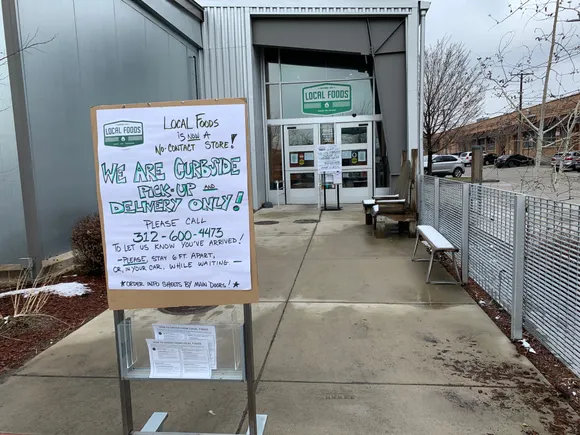
"If your store is small, not in a high-traffic area, and you have a sufficiently flexible workforce, I think you can make the transition," Jim Carbine, CEO of Local Foods in Chicago, told Grocery Dive. The company converted its retail store to pickup and delivery only last week.
However, moving store operations entirely online can also bring operational complexity and high costs. Italian Cowboy, a small specialty store in Rockland, Texas, that sells wine, home goods, and groceries, tried offering pickup to customers. But the store, which primarily serves wealthy clients along the Texas coast, struggled to handle phone orders and couldn't provide the high-touch service it's known for. The store also serves many elderly and immunocompromised customers.
Last month, owners Lowell and Deidra Rothschild decided to temporarily close the store.
"We just felt we couldn't provide a safe enough environment while giving customers the experience and customer service they deserve," Lowell Rothschild told Grocery Dive.
Advantages of independent grocers
Independent grocers may be best positioned for the transition because they can adjust quickly and typically have loyal customer bases, Carbine said. He said Local Foods has gained new customers in recent days because shoppers know they can book a pickup slot for the next day.
But the same independent grocers may struggle to quickly shift business models and scale e-commerce systems. The Takoma Park/Silver Spring Co-op, which previously didn't offer online shopping, spent four days around the clock adding an ordering platform to its website, including entering 13,000 items one by one. Shortly after launching on Saturday, March 28, the site crashed for four hours due to a surge in demand.
"We have a very loyal membership community. They immediately flocked in and started placing orders," Houston said.
Carbine and the Local Foods team spent a weekend urgently reviving a home delivery service that had just been discontinued and designing a system for picking, packing, and delivering orders. In addition to online ordering, the store accepts phone and email orders, which helps less tech-savvy shoppers and provides extra customer service, but also requires a lot of back-and-forth communication.

Carbine said the decision to close the store to customers was "very controversial" on the board. The store was setting sales records at the time, which helped support Local Foods' struggling wholesale business—which serves many Chicago-area restaurants that have recently closed and is currently running at about 15% capacity.
"We're probably making a bad economic decision, and I have to accept that. But I know we're making a very good decision here from a customer and employee safety standpoint," he said.
Nearly two weeks into the new operating model, things are running more smoothly. Local Foods has refined its system: employees pick items in the aisles like regular customers and scan them at checkout, then place orders in a staging area before handing them to customers. The store initially used phones at each register to take orders; now employees wear headsets and chat with customers as they walk through the aisles.
"If your store is small, not in a high-traffic area, and you have a sufficiently flexible workforce, I think you can make the transition."
Jim Carbine
CEO, Local Foods
Carbine said he hasn't laid off any of his roughly 50 employees, including delivery drivers, about half of whom now work full-time in the retail store.
"My team of drivers is now picking orders in the store," Carbine said.
The Takoma Park/Silver Spring Co-op has also learned a lot in a few days about optimizing labor and supply. Still, Houston said operations are a work in progress. Nearly all of the store's refrigerated cases are now used to hold customer orders. Its e-commerce site is far from the Amazon or Instacart experience, doesn't yet recognize member benefits, and doesn't accept SNAP payments. To cater to shoppers who don't want to search and browse online, the store offers pre-packed bags with a rotating mix of groceries, dairy, meat, and gluten-free items.
"I've been calling it the 'I don't care what I get' option," Houston said. "It's kind of like a CSA model."
For retailers considering the shift to a "dark store" model, Houston recommends setting an implementation timeline but also being prepared to adjust quickly once the new model launches. Meanwhile, Carbine said he questioned himself shortly after making the decision because the safety benefits weren't immediately apparent, and he cautioned other managers to expect that second-guessing. He said it's crucial to have broad support from all company stakeholders because businesses need to act quickly and decisively.
"If you have a divided team and can't get everyone on board with the decision, I think you'll fail," Carbine said.
Looking ahead, Houston sees reasons for optimism, including order volume continuing to grow as existing shoppers adapt to the new system and new customers hear about it. The store serves fewer customers than when it was open, with just over 300 orders per day on average, but average order values have risen significantly, ranging from $20 to $500. In the coming weeks, Houston plans to add categories online that were initially deferred, such as beer, wine, and bulk items.
Houston said closing the store was especially difficult given the strong connection members have with the store. A recent survey the store conducted found that more than half of members shopped in-store more than once a week.
"Closing the store was emotionally really hard," Houston told Grocery Dive. "I stand by the decision, but it wasn't easy."